The Ultimate Movement Roadmap (Part 1): Your 4-Stage Journey to Kinetic Power
The Ultimate Movement Roadmap: Your 4-Stage Journey to Kinetic Power
Reclaiming Your Biological Foundation
In a world where high achievers often trade their physical vitality for professional gain, we are unknowingly succumbing to a "silent decay" of our most valuable asset: our body. This article serves as your comprehensive guide to reclaiming that lost potential, moving beyond basic exercise to master the science and strategy of Kinetic Power.
What You’ll Gain from This Blog
Through a series of high-impact self-reflection questions, we will identify your current performance bottlenecks and map out a sustainable path to peak health. By adopting our unique Kinetic Power Progression Pyramid, you will finally unlock the superior energy, mental clarity, and resilience necessary to sustain your success. Let’s dive into how you can start investing in your high-performance foundation today to experience immediate, life-changing dividends.
1. The Movement Audit: Identifying Your Bottlenecks
The Neuroscience Behind Bottlenecks
Before building a high-performance foundation, we must identify where your system is currently leaking energy. Bottlenecks are hidden mechanical and physiological limitations that prevent you from reaching your true cognitive and physical capacity.
Critical Questions (The Diagnostic)
Ask yourself these questions to determine if you are currently operating with performance bottlenecks:
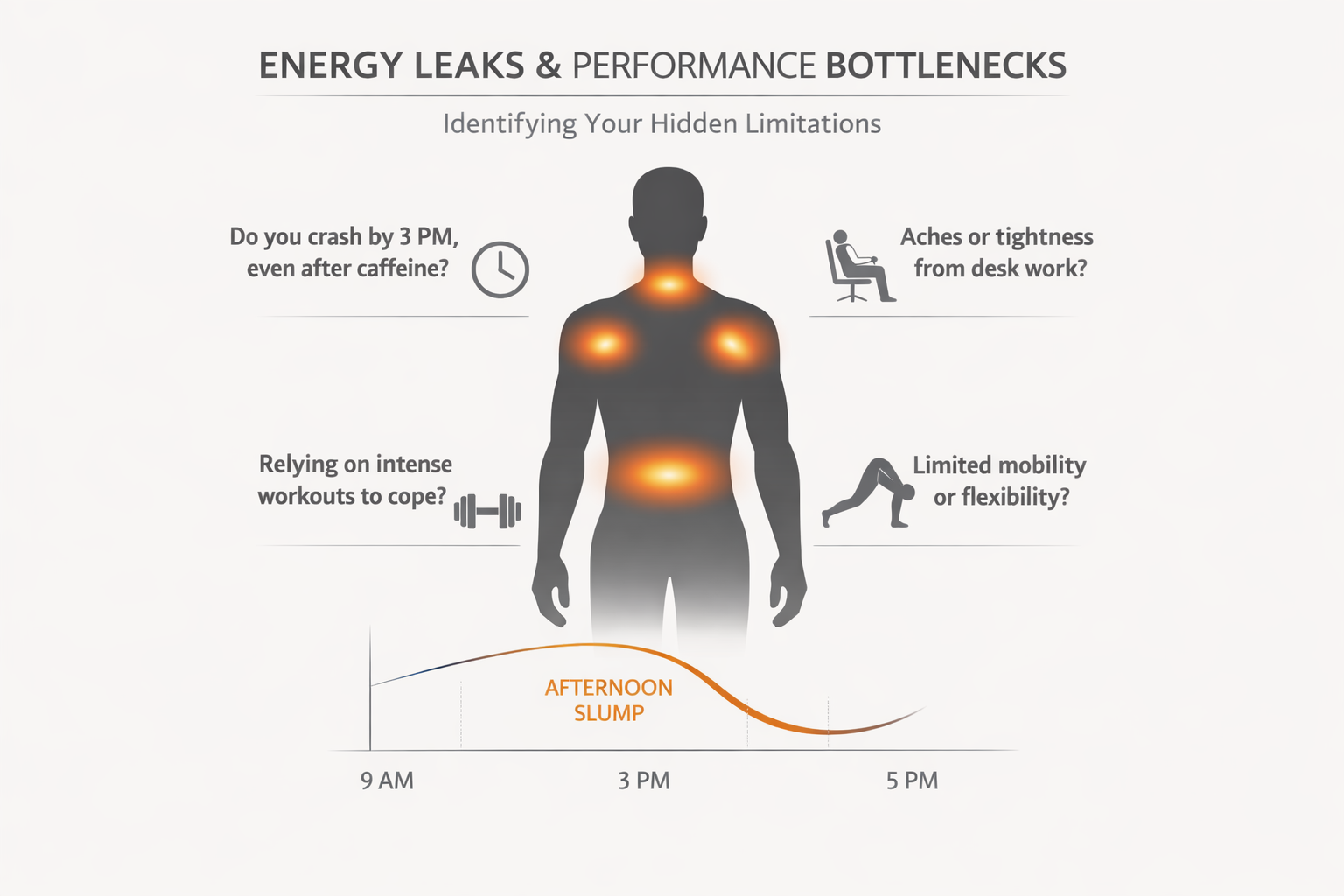
The Afternoon Slump: Do you experience a significant drop in mental focus by 3:00 PM, even after caffeine?
Structural Integrity: Does your body signal distress—via "tech neck," shoulder tightness, or lower back pain—after just two hours of seated work?
The "Intensity Trap": Do you rely on high-intensity training to "burn off" stress, only to find yourself feeling more drained and injury-prone the next day?
Functional Range: Can you move through full, pain-free ranges of motion (squatting, reaching, rotating) without relying on compensatory movement patterns?
Example
If you answered "yes" to these questions, you are experiencing performance bottlenecks. The "Afternoon Slump" is a classic example: if focus drops by 3:00 PM despite caffeine, your body is signaling systemic fatigue—a bottleneck that requires a movement reset rather than more stimulants. If these physical signals are triggering mental frustration, see my guide: The Stress-Free Professional: A Strategic Guide to Burnout Prevention.
Techniques for Increasing Self-Awareness
You must audit your day to identify exactly where physical stress manifests.
Log your energy: For one day, track your focus levels at 10 AM, 2 PM, and 5 PM to correlate focus with your daily routine.
Identify the pain point: Note the exact time physical stiffness begins during your workday.
Set your timer: Configure your phone or computer to alert you every 120 minutes for a mobility reset.
Practical Tips
The "Two-Hour Reset": To combat structural decay, set a recurring alarm for every two hours. Spend 60 seconds performing "desk-based" mobility: reach your arms overhead to open the chest, perform slow neck circles, and execute five controlled hip hinges. This breaks the sedentary cycle before pain signals start.
By addressing these bottlenecks head-on, you clear the path to building a truly resilient physical foundation. Now that we have identified the common hurdles, it is time to look at the "Return on Investment" of your physical habits—let’s explore how strategically investing in your foundation pays off in every area of your life.
2. The Movement ROI: Investing in Your High-Performance Foundation
The Neuroscience Behind Biological Assets
Movement is not merely physical activity; it is a "longevity drug" and a cognitive performance enhancer. Activity modulates critical biological pathways—including the FOXO family of genes—which govern cellular repair, stress resistance, and the mitigation of biological wear and tear.
Example
Think of your cardiorespiratory capacity as a biological savings account. Engaging in "Zone 2" training (steady-state movement like brisk walking or cycling) increases mitochondrial density. This provides the physiological "interest" that allows your body to recover faster from a high-stress, 12-hour workday.
Techniques for Increasing Your Movement ROI
You must shift toward strategic movement—high-leverage habits that maximize physiological yield.
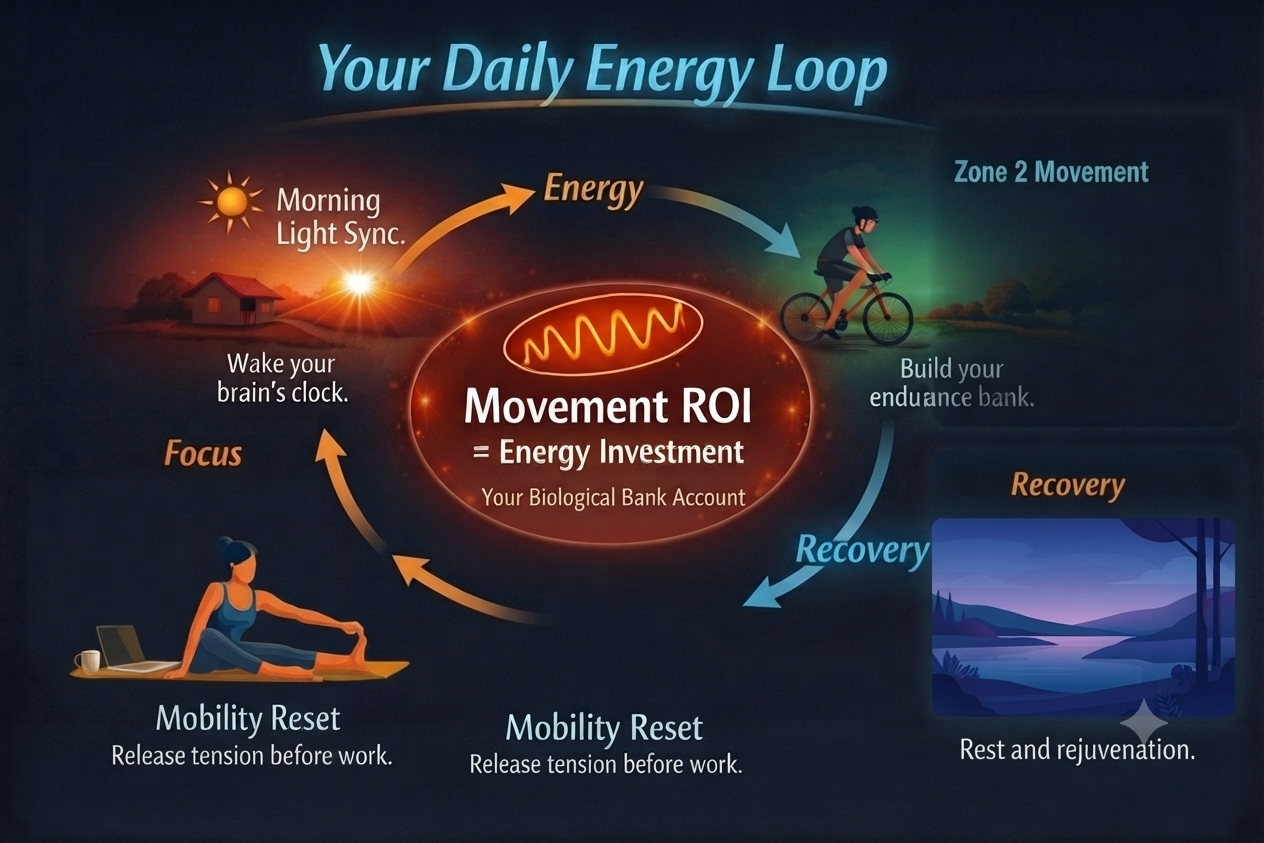
Circadian Morning Sync: Get 5–10 minutes of direct natural light exposure shortly after waking to reinforce your internal clock and optimize evening recovery. Syncing your biology is foundational; read more here: The Sunlight Advantage: Enhancing Productivity and Performance.
Zone 2 Investment: Dedicate two 30-minute blocks this week to "conversational pace" movement to bolster your aerobic capacity.
Repay Your Debt: Identify one area of "structural drag"—such as tight thoracic musculature from desk work—and dedicate 5 minutes of focused mobility to it before your first meeting.
Critical Questions
Do you view exercise as a time-costly expenditure rather than a "longevity drug" that pays compounding dividends?
Are you currently accumulating "performance debt" through structural inefficiencies that tax your cognitive bandwidth?
Practical Tips
High-Leverage Calibration: Stop viewing movement as "hours in the gym." Shift toward a 10-minute mobility flow (like "Cat-Cow" stretches or "Thoracic Extensions") during transition periods to alleviate postural strain.
By shifting from time-costly 'exercise' to high-leverage movement, you have already cleared the path to higher biological ROI. However, even the most efficient movement is wasted if it doesn't align with your brain's unique neural architecture. Let’s look at the science of movement quality to see how you can upgrade your physical routine into a precision tool for cognitive clarity.
3. The Science of Better Movement
The Neuroscience Behind Movement Quality
If performance is the goal, movement must be treated as a precision tool. Strategic movement stimulates the release of BDNF (Brain-Derived Neurotrophic Factor), a growth factor for your brain that enhances neuroplasticity, memory formation, and the mental clarity required for complex decision-making.
Example
Before a high-stakes presentation, avoid prolonged sedentary positioning. A brisk 5-minute walk increases blood flow and upregulates BDNF, essentially "priming" your hippocampus to function more effectively under pressure.
Techniques for Increasing Movement Quality
We must combat "active couch potato" syndrome by adopting "movement snacks"—frequent, low-intensity movement bursts distributed throughout the day.
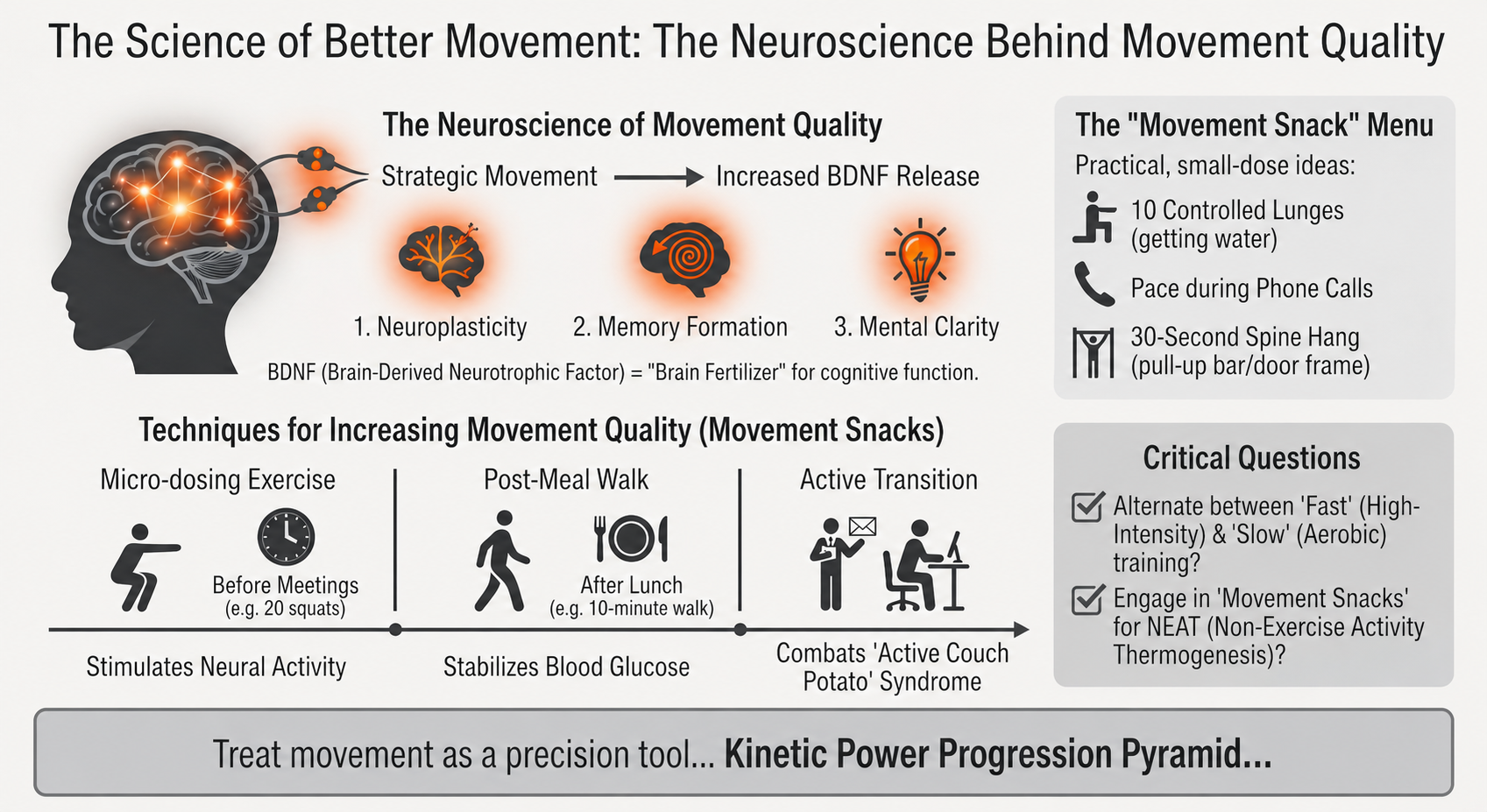
Micro-dosing exercise: Perform 20 bodyweight squats before each major meeting to stimulate neural activity. These physical resets pair perfectly with mental shifts; learn how in: Improve Mental Health with Emotional Intelligence.
Post-meal walk: Take a 10-minute walk immediately after your lunch to stabilize blood glucose.
Active transition: Swap one sedentary email-check for a standing or walking check-in.
Critical Questions
Do you strategically alternate between "fast" (high-intensity) and "slow" (aerobic-base) training to prevent systemic burnout?
Are you engaging in "movement snacks" to keep your metabolism active and encourage non-exercise activity thermogenesis (NEAT)?
Practical Tips
The "Movement Snack" Menu: View movement as a continuous stream—perform 10 controlled lunges when getting water, pace during phone calls, or use a pull-up bar or door frame to hang for 30 seconds to decompress the spine.
We have now decoded how to turn movement into 'brain fertilizer' and metabolic fuel. But knowledge alone doesn't create durability; you need a system to organize these 'movement snacks' into a cohesive lifestyle. Let’s look at the Kinetic Power Progression Pyramid to see how to organize these pieces into a blueprint that guarantees long-term physical and professional results.
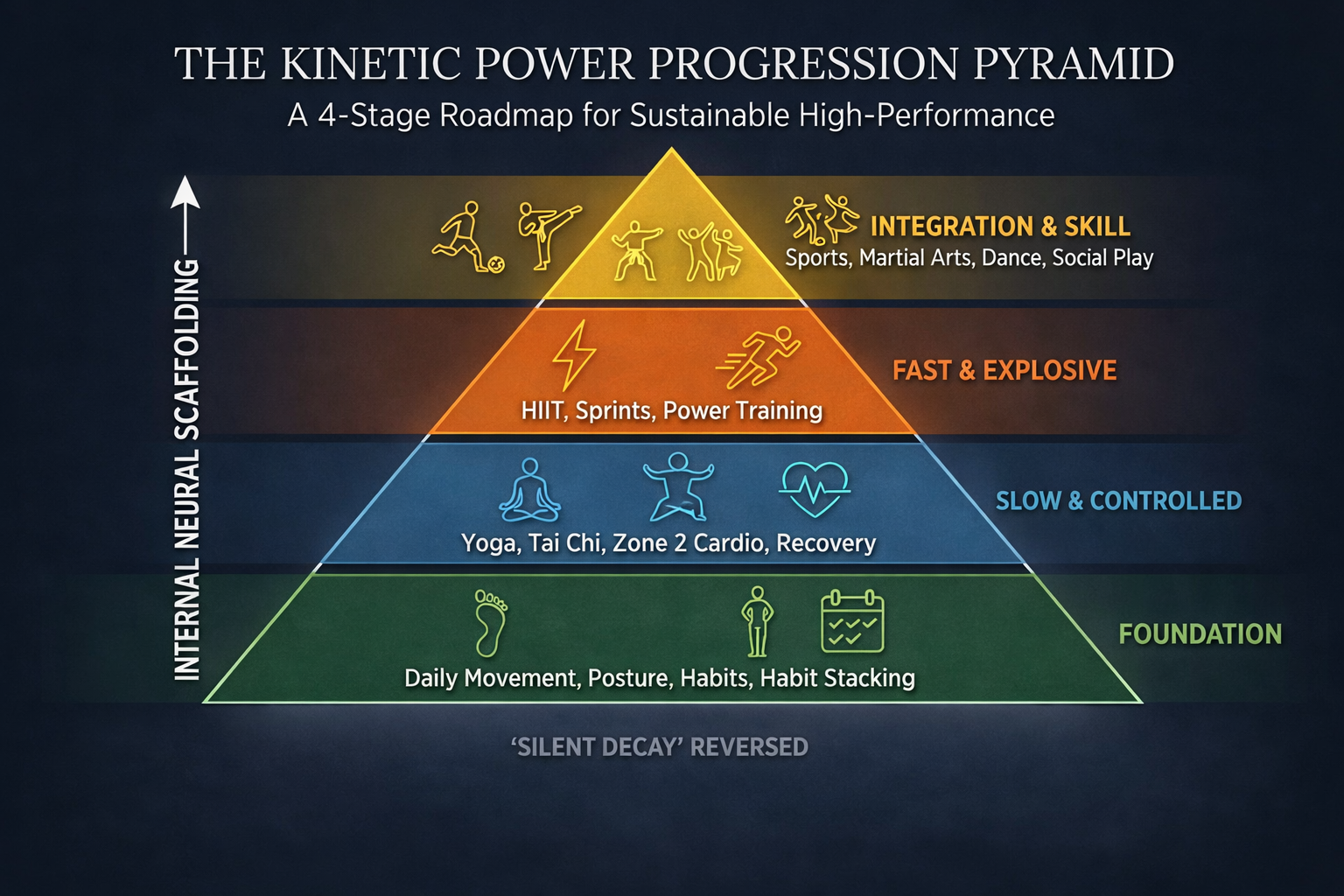
4. The Kinetic Power Progression Pyramid
The Neuroscience Behind Structural Readiness
Kinetic Power is the refined capacity to move with intention, resilience, and explosive potential. By prioritizing biomechanical alignment, you reduce "internal friction"—the energy wasted when muscles fight against each other—allowing you to apply force more efficiently. We build the base before increasing the load to ensure your "internal wiring" is intact.
Example
Before you load a barbell, you must master the "hinge" pattern. By perfecting your pelvic alignment and core bracing during simple, bodyweight movements, you build the internal neural "scaffold" that keeps your spine safe when you eventually progress to higher-intensity loads.
Techniques for Increasing Foundational Integrity
We utilize a tiered approach, prioritizing foundational movement—posture, balance, and proprioception—to create the necessary scaffold for higher-intensity training.
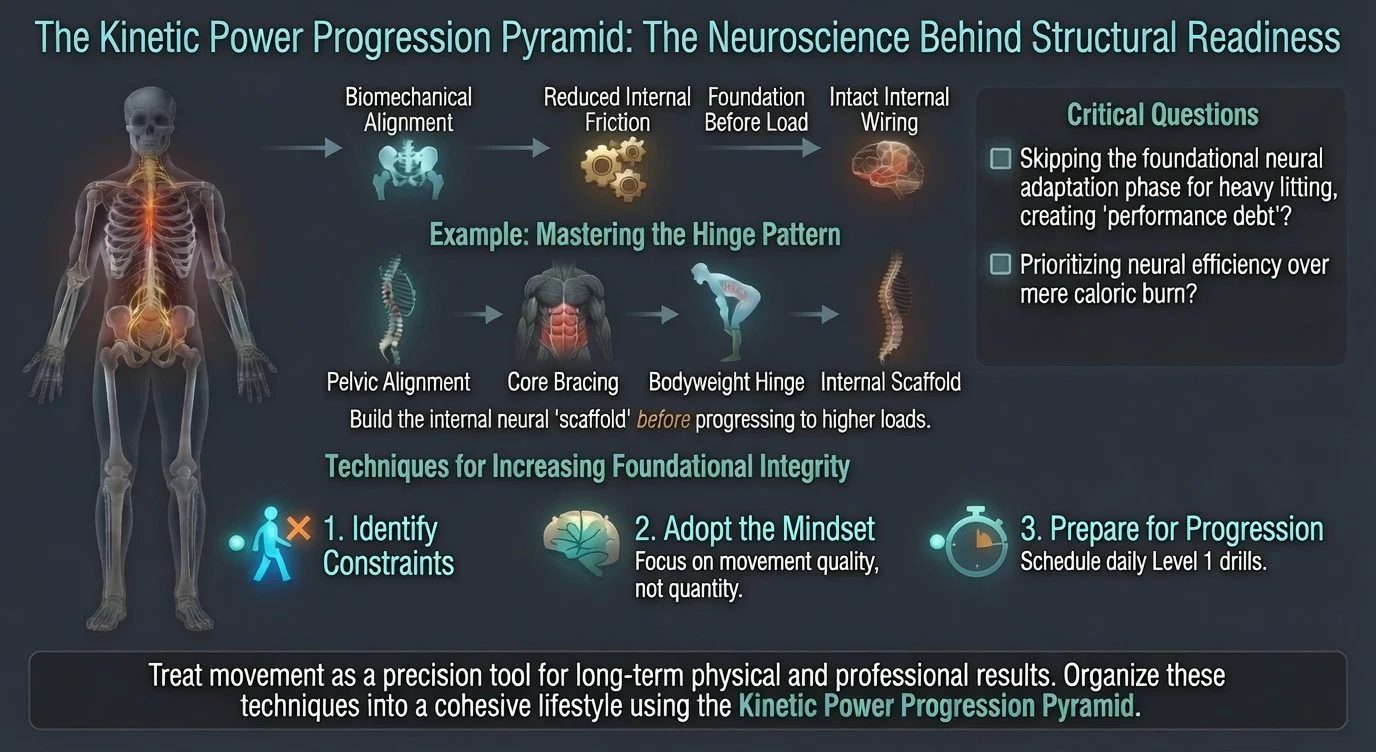
Identify your constraints: Audit the biggest physical "roadblock" in your day.
Adopt the Mindset: Commit to the idea that your next training session should be focused on quality of movement—perfecting your internal "wiring"—rather than quantity of exertion. Consistency is a challenge; if you struggle to prioritize these habits, check out: Overcoming Procrastination.
Prepare for Progression: Clear a 5-minute window in your daily schedule to begin implementing Level 1 drills. Facing psychological hurdles with these drills? Explore my tips here: How to Deal with Anxiety: 7 Strategies for Reducing Stress.
Critical Questions
Are you skipping the foundational neural adaptation phase and jumping straight into heavy lifting, creating "performance debt"?
Does your training prioritize neural efficiency over mere caloric burn?
Practical Tips
Validate Your Foundation: Attempt a 60-second plank with perfect form. Perform a bodyweight squat in front of a mirror; if your heels lift or chest collapses, prioritize mobility work before adding weight.
You now possess the four-stage framework required to build an unbreakable physical foundation and reverse the 'silent decay' of a high-pressure lifestyle. The only remaining step is to transition from understanding the theory to experiencing the transformation—let’s look at how you can integrate these evidence-based strategies into your life today.
What’s Next in the Roadmap
In our next installment, we will dive into the very base of the pyramid: Level 1. We will move past theory and into the specific "movement snacks" and foundational drills that make everything else in your physical development possible. Together, these foundational building blocks will establish the essential biomechanical integrity required to elevate your physical performance and unlock the full potential of the levels to follow.
Get the free Kinetic Power Starter Kit
Workbook + one-page Implementation Map + 12-minute audio.
Complete Stage 1 in the next 15 minutes.
Ready to Transform Your Kinetic Power?
At Omirakai, I help busy professionals bridge the gap between their demanding schedules and their need for physical vitality by implementing sustainable, evidence-based movement strategies. Rather than prescribing rigid workouts, I work with you to engineer a "movement ecology"—a custom-built system that treats every hour of your workday as an opportunity to boost your cognitive clarity, reduce physical strain, and systematically reverse the "silent decay" caused by a high-pressure lifestyle.
Here is what our clients have achieved by applying these principles:
"Since working with Umar and staying consistent with the movement practices he’s guided me through, I’ve seen real improvement in my hip mobility. My discomfort has eased noticeably too, down significantly compared to what it used to be." — Melvin Joy. Derby. UK.
Our Health Coaching Program helps you:
Integrate physiological wellness into your career by identifying and eliminating the physical bottlenecks that drain your cognitive energy.
Cultivate a foundation of sustainable health by refining your neural efficiency, ensuring every movement serves to replenish—rather than deplete—your energy levels.
Harmonize your professional and personal life by seamlessly weaving evidence-based movement strategies into your existing schedule.
Build the systemic durability required to thrive in high-pressure environments, ensuring your physical vitality supports your long-term ambitions.
Ready to begin your science-based journey to peak performance? Explore Health Coaching →
Your journey to high performance starts with a single, intentional movement toward a more resilient version of yourself - starting today!